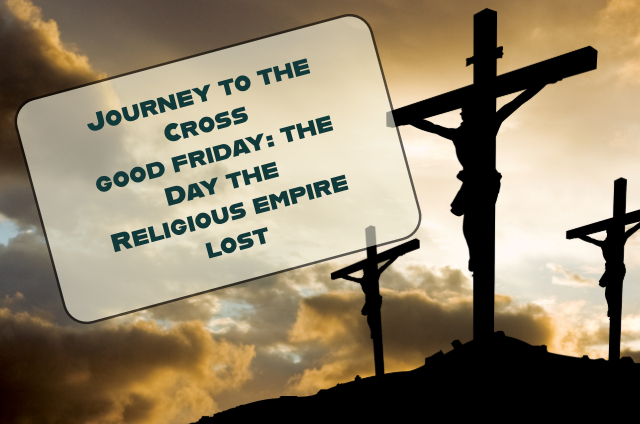
Text: John 19:30 (KJV) “When Jesus therefore had received the vinegar, he said, It is finished: and he bowed his head, and gave up the ghost.”
Good Friday.
The darkest day in Christian memory. The day the sky turned black. The day love was lynched by empire and religion in a coordinated act of public humiliation and terror.
For centuries, we’ve treated Good Friday with somber reverence—and rightly so. But far too often, we domesticate it, sentimentalize it, or misunderstand it. Good Friday isn’t just about a tragic death. It is the day when the world’s powers—political, religious, military—were fully exposed for what they are.
Good Friday is not the story of a good man wrongfully accused. It’s the story of a new kind of power confronting the old — and getting crushed by it. Or so it seemed.
Because when Jesus said “It is finished,” He wasn’t admitting defeat. He was announcing victory.
The Cross Was a Political Execution
Let’s be clear: crucifixion was not a private affair. It wasn’t a religious ceremony. It was a public, state-sponsored warning.
Rome used crucifixion to send a message: “This is what happens to anyone who challenges our authority.”
- Rebels were crucified.
- Insurrectionists were crucified.
- Slaves who defied masters were crucified.
And Jesus? He was nailed to a Roman cross because He led a movement that threatened to upend the status quo.
His crimes were listed in mockery above His head:
“Jesus of Nazareth, King of the Jews.”
It wasn’t just sarcasm. It was accusation.
Jesus had claimed a kingship that didn’t bow to Rome. He had staged a counter-procession into Jerusalem. He had denounced the temple authorities. He had redefined power, loyalty, and belonging.
The powers—Rome and the temple leadership—decided He had to die.
But they didn’t realize: killing Him was their ultimate exposure.
The Complicity of Religion and Empire
Good Friday unmasks not just Rome but religion.
It wasn’t just Pilate’s soldiers who condemned Jesus. It was the collusion of religious leaders—priests, elders, experts of the law—who orchestrated His arrest and trial.
The temple authorities were not shocked by Jesus’ death. They demanded it.
Because Jesus had exposed their game:
- A temple turned marketplace.
- A priesthood aligned with Caesar.
- A faith that hoarded holiness for the few and excluded the many.
Jesus healed without a license. Forgave without a temple. Proclaimed a kingdom without borders.
He bypassed their control.
So they traded faithfulness for survival. They chose the security of empire over the risk of true discipleship.
“We have no king but Caesar.” (John 19:15)
They said it with their mouths. They confirmed it with His blood.
The Cross as the Throne of a New Kingdom
Good Friday is not just about what the powers did. It’s about what Jesus did.
The Gospel of John portrays the crucifixion not as humiliation but as enthronement.
- The crown of thorns is His crown.
- The cross is His throne.
- The mock inscription is the world’s truest proclamation.
Jesus reigns, not by inflicting violence, but by absorbing it. Not by dominating, but by descending. Not by killing, but by dying.
In the Roman world, kings paraded their power through conquest. Jesus displays His kingship through surrender.
This is not weakness. It is power perfected in sacrifice.
It is a new kind of reign the world had never seen. And the old world couldn’t comprehend.
The Crowd and the Crisis of Discipleship
Where are the crowds who shouted “Hosanna” just days earlier? Gone. Silent. Complicit.
Good Friday confronts us with a brutal question:
When power flexes its muscle, where do we stand?
The disciples fled. Peter denied. The faithful few watched from a distance.
It’s easy to worship Jesus when the crowd cheers. It’s much harder when the mob demands crucifixion.
Good Friday demands that we examine our loyalties:
- Do we follow the suffering servant?
- Or do we bow to the stability of empire?
Because make no mistake: the cross is still scandalous. It still divides. It still asks us to choose.
The Curtain Torn: Access for All
“And, behold, the veil of the temple was rent in twain from the top to the bottom.” (Matthew 27:51)
The curtain in the temple separated the Holy of Holies—the place of God’s presence—from the people.
Only the high priest could enter. And only once a year.
When Jesus died, that barrier tore. From top to bottom.
God tore it. Not humanity.
The message was clear:
- No more gatekeepers.
- No more exclusion.
- No more hierarchy between God and humanity.
Through the broken body of Jesus, the way was opened. Not just for priests. Not just for the “clean.” Not just for the insiders.
For all.
The empire tried to silence Him. The temple tried to contain Him.
But the death of Jesus dismantled both.
Good Friday Is Still Happening
If Good Friday teaches us anything, it’s that power systems still conspire against truth.
- Empire still executes prophets.
- Religion still sells out for comfort.
- Crowds still turn with the tide.
The question is not whether Good Friday happened. It’s whether it is happening now — and where we stand.
Are we with the silent disciples? The bloodthirsty crowds? The empire’s enforcers? The temple’s protectors?
Or are we willing to follow the crucified king, even when it leads to Golgotha?
Because the cross is not just something done for us. It is a path laid before us.
Jesus said:
“If any man will come after me, let him deny himself, and take up his cross, and follow me.” (Matthew 16:24)
The cross is not a get-out-of-jail-free card. It’s a summons.
A call to the way of sacrificial love. A call to confront injustice. A call to dismantle systems of death.
Even at great cost.
It Is Finished—But Not Over
When Jesus declared, “It is finished,” He didn’t mean He was finished. He meant the system was finished.
- The system of domination.
- The system of religious control.
- The system of death dealing.
He unmasked them. He took their worst. And He drained their power.
But the story doesn’t end with “It is finished.” It continues in every act of courage. Every act of defiant love. Every act of hope in the face of despair.
Good Friday isn’t just the day Jesus died. It’s the day the world’s old story of power died.
And a new story was born.
The Cross Still Stands
Good Friday is uncomfortable. And it should be.
Because it calls us to look honestly at our world — and at ourselves.
- Where are we complicit in systems of oppression?
- Where are we silent when truth is crucified?
- Where are we clinging to power instead of kneeling in surrender?
Jesus’ crucifixion wasn’t an accident. It was the inevitable result of a life lived fully for the kingdom of God.
And if we live for that kingdom, we should not be surprised if we, too, find ourselves at odds with empire and religion alike.
The cross is not just Jesus’ burden. It’s ours.
Not to die for sin. But to die to self.
To die to:
- Fear.
- Pride.
- Power hunger.
- Comfort.
And to rise in love.
Because while Good Friday ends in death, it doesn’t end in defeat.
Sunday is coming.
But first—we must pass through Friday. We must sit with the scandal. We must reckon with the cost.
Only then can we fully grasp the glory.
The empire thought it won. Religion thought it protected itself. The crowd thought it chose wisely.
But the cross stands as an eternal reminder:
God’s kingdom does not come by crushing others. It comes by bearing the cross.
And that, not empire, is the true power that endures.
Amen.